<?xml version="1.0" encoding="utf-8"?><feed xmlns="http://www.w3.org/2005/Atom" xml:lang="en"><generator uri="https://jekyllrb.com/" version="4.4.1">Jekyll</generator><link href="https://ajspig.github.io/feed.xml" rel="self" type="application/atom+xml" /><link href="https://ajspig.github.io/" rel="alternate" type="text/html" hreflang="en" /><updated>2026-11-26T09:56:51+00:00</updated><id>https://ajspig.github.io/feed.xml</id><title type="html">Abigail Spigarelli</title><subtitle>A personal website for Abigail Spigarelli</subtitle><author><name>Abigail Spigarelli</name></author><entry><title type="html">Staying current: How to curate your AI news feed</title><link href="https://ajspig.github.io/posts/Staying-Current/" rel="alternate" type="text/html" title="Staying current: How to curate your AI news feed" /><published>2026-07-14T00:00:00+00:00</published><updated>2026-07-14T00:00:00+00:00</updated><id>https://ajspig.github.io/posts/Staying-Current</id><content type="html" xml:base="https://ajspig.github.io/posts/Staying-Current/"><![CDATA[<p>(This was originally presented at <a href="https://www.pursuit.org/ai-native-program">Pursuit</a> on June 30th, 2026. <a href="https://www.menti.com/al6abqopwkwf">Slide deck here</a>. Skip to the end if you want the narrative. Also, it’s not in a “perfect” state, and I need to be fine with that and just publish it. BTW claude only helped clean up the spelling &amp; grammar mistakes.)</p>

<h2 id="why-do-you-want-to-stay-current-with-ai-news">Why do you want to stay current with AI news?</h2>

<p>A plan flows a lot easier when there is a clear purpose. Knowing what is important to you is the first step to curation. Curation also implies control. Your AI news feed serves you. In no way do you serve an algorithm or the media cycle. So what is your purpose when you read a newsletter, attend an event, engage with content on LinkedIn, or scroll the front page of Hacker News?</p>

<p>You are enrolled in Pursuit, which has the following purpose:</p>

<blockquote>
  <p>Pursuit is equipping you with AI skills, community, and network to get hired and thrive in an AI-first world.</p>
</blockquote>

<p>This mission statement connects with three primary pillars: AI skills, community, and network. And all this is not just to get hired (’cause you are so much more than a job), but also to thrive. This is for you. This is for your learning journey.</p>

<p>As we check in with your current news feed and discover what should be improved and changed, make sure it’s aligned with your purpose. Adopting Pursuit’s as your own works. Other ideas might surface as we walk through some exercises.</p>

<p>To assess your AI news feed, think back to one thing you learned this week about the AI world that engaged you and piqued your curiosity. Maybe you added your two cents to a tweet. Maybe it’s a technical project that uses or supports AI. Maybe a geopolitical event directly related to AI technologies.</p>

<p>Now think about your source for this piece of news. Did you find it in a newsletter? Social media? Pursuit (event, mentor, class, friend)? Tech event? Traditional news feed? Something else?</p>

<p>This is just one example, but curiosity is a great signal. Your news feed should feed and build your curiosity. So how is your feed doing? What technical skills are you learning via your AI news feed? Whose content are you engaging with? Are you producing content that builds communities and networks around you?</p>

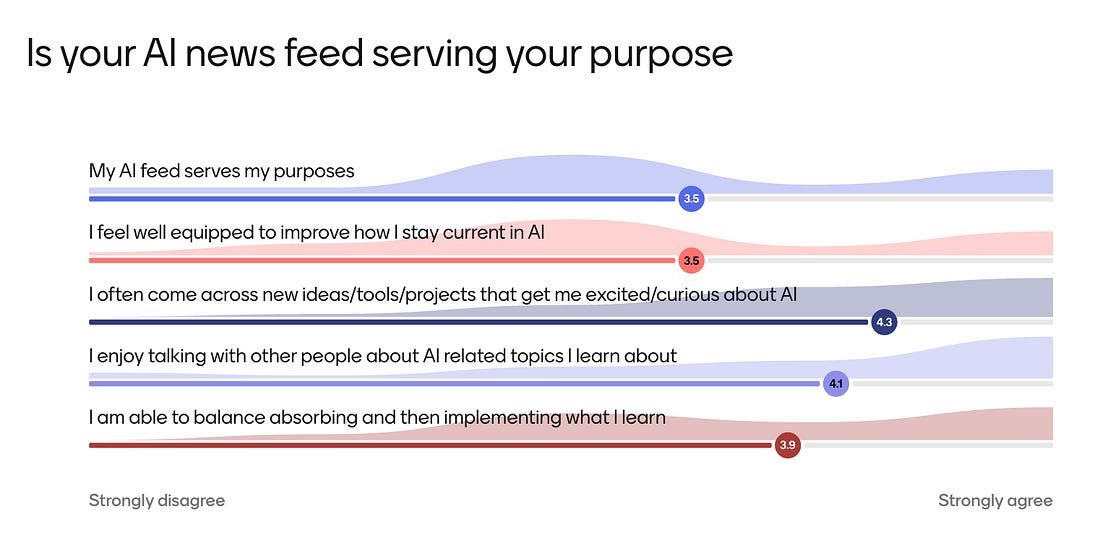
<p>On a scale of 1–5, how much do you agree with the following:</p>

<ul>
  <li>My AI feed serves my purposes</li>
  <li>I feel well equipped to improve how I stay current in AI</li>
  <li>I often come across new ideas/tools/projects that get me excited/curious about AI</li>
  <li>I enjoy talking with other people about AI-related topics I’m learning</li>
  <li>I am able to balance absorbing and then implementing what I learn</li>
</ul>

<p><img src="/assets/img/post-resources/staying-current/responses-chart.png" alt="Survey results, averaged on a 1 to 5 scale: My AI feed serves my purposes, 3.5. I feel well equipped to improve how I stay current in AI, 3.5. I often come across new ideas, tools, and projects that get me excited about AI, 4.3. I enjoy talking with other people about AI-related topics, 4.1. I am able to balance absorbing and then implementing what I learn, 3.9." />
<em>Pursuit’s Responses</em></p>

<h2 id="my-experience">My experience</h2>

<p>In November I joined <a href="https://plasticlabs.ai/">Plastic Labs</a> to support building <a href="https://honcho.dev/">Honcho</a>, AI memory infrastructure. Previously I worked at <a href="https://careers.leidos.com/pages/leidos-office-of-technology">Leidos</a> on their internal AI offerings. At Leidos I had a lot of flexibility in what I worked on and would set aside time in my workday to read papers, browse Hacker News, and try out new GitHub repos.</p>

<p>In this new role at Plastic Labs I was qualified, but the environment felt drastically different. I was jumping from a company with 47,000 employees to 8. My coworkers were sharing sources and talking about AI labs in ways I had never thought about. The quantity and speed of information was much faster and denser.</p>

<p>I also learned about Twitter as an AI news source. I created my first Twitter account, and one of my responsibilities involved posting on Twitter every day. I quickly observed some differences between that platform and other news sources.</p>

<p>It didn’t take long to feel the anxiety and pressure to be “better at keeping up.” A pretty vague mission statement. I felt overwhelmed by the quantity of information, ideas, and headlines holding my attention.</p>

<p>Now that was November. Eight months later, things are not solved. I don’t have my AI news feed “figured out.” But things are better. I feel less overwhelmed, and more of my attention is spent on things that spark my curiosity (vs. drain me). I don’t serve the algorithm, and I am in a better place for balancing the tension between absorbing and implementing the things I learn.</p>

<h2 id="a-couple-things-ive-learned">A couple things I’ve learned</h2>

<p>Things are not perfect, but this experience taught me a lot. I want to share a couple of resources and ideas that I’ve learned.</p>

<p>Sources are really important. Who wrote this? What have they been building? Why do they care? What are their incentives? AI news can easily disintegrate into complexity theater, and a lot of claims are made that have no validation. If my curiosity is piqued (which, if my information sources are structured correctly, it should be), I’ll build and test and prove out the idea myself.</p>

<p>Some ideas for sources: this list is certainly a lot longer than my personal feed, but I wanted to talk through some of the options and possibilities.</p>

<h3 id="sites">Sites</h3>

<ul>
  <li><a href="https://news.ycombinator.com/">Hacker News</a> — broad tech</li>
  <li>lobste.rs — smaller, more technical</li>
  <li><a href="https://github.com/trending">GitHub Trending</a></li>
  <li><a href="https://huggingface.co/">Hugging Face</a> — what’s being built (<a href="https://huggingface.co/papers">Daily Papers</a> for what’s published)</li>
  <li><a href="https://www.reddit.com/r/LocalLLaMA/">r/LocalLLaMA</a> — open models, quantization, local inference</li>
  <li><a href="https://www.alphaxiv.org/">alphaXiv</a> — arXiv papers with discussion</li>
  <li><a href="https://paperswithcode.com/">Papers with Code</a></li>
  <li>Lab blogs — primary source, earliest: <a href="https://www.anthropic.com/news">Anthropic</a>, <a href="https://openai.com/news/">OpenAI</a>, <a href="https://deepmind.google/discover/blog/">Google DeepMind</a>, <a href="https://mistral.ai/news">Mistral</a>, <a href="https://allenai.org/blog">Ai2</a></li>
  <li>Package release feeds — dependency news as a feed: <a href="https://www.npmjs.com/">npm</a>, <a href="https://pypi.org/">PyPI</a>, crates.io</li>
  <li>RSS reader</li>
</ul>

<h3 id="newsletters">Newsletters</h3>

<ul>
  <li><a href="https://every.to/">Every</a> — essays, business/product angle</li>
  <li><a href="https://tldr.tech/ai">TLDR AI</a> — daily, fast scan of news and papers</li>
  <li><a href="https://www.lennysnewsletter.com/">Lenny’s Newsletter</a> — product, not very technical</li>
  <li><a href="https://www.bensbites.com/">Ben’s Bites</a> — builder/business, now leans AI investing</li>
  <li><a href="https://www.latent.space/">Latent Space</a> — AI engineering: agents, evals, inference</li>
  <li><a href="https://www.interconnects.ai/">Interconnects</a> — RL, open models, frontier labs (Nathan Lambert)</li>
  <li><a href="https://www.deeplearning.ai/the-batch/">The Batch</a> — weekly research framing (Andrew Ng)</li>
</ul>

<h2 id="simplifying">Simplifying</h2>

<p>The sources listed here are not comprehensive and are just meant to spark some ideas. In no way should your takeaway from this be “I need to add more.” In fact, I expect most of the focus to be on simplifying. We live in a very information-dense environment, but we are finite, attention-limited beings. You can only process a small sliver of that information, and only some of it will be relevant to you.</p>

<p>To be sure of this, conduct regular check-ins with yourself and see what needs to be simplified.</p>

<p>With this in mind, I will leave you with one final question: What is one action you can take this week to improve your AI news feed?</p>

<h2 id="what-the-process-was-like-for-those-curious">What the process was like (for those curious)</h2>

<p>One of the first post-presentation questions was: “Why did you choose this topic? It feels helpful but also very specific.” To answer, I found I needed to start at the beginning.</p>

<p>Back sometime in April, I did a quick, spur-of-the-moment presentation for my mentee’s cohort on open source contributions. I loved it. The builders paid close attention and asked lots of great questions. I felt well suited to deliver valuable content because of my recent work in OSS. Because of the short notice, the pressure to “perform” felt low.</p>

<p>Afterward, I talked with their instructor and offered to do it again on the same topic or something else. After a bit of back-and-forth, we found a date three months later, and I decided to talk about something new to stretch myself. With my mentee at the time, I wanted to discuss AI news and new projects. I found this to be a valuable transfer of knowledge and felt like there might be a larger opportunity across Pursuit around how to keep up with AI news. Thus, the topic was born.</p>

<p>In the back of my head, I knew I’d probably regret this later. However, I felt confident that this would stretch me and be a good experience. I also felt confident I could talk about this topic. Not because I was the most up-to-date person, but because it’s something I’ve tried to be intentional about.</p>

<p>I had ample time to prepare, but most of the prep happened the week before, specifically the Saturday before. Having ample time seemed to impede my ability to focus. Additionally, they asked me to talk for 30–40 minutes, which felt significantly longer than the 10 I had spoken before.</p>

<p>And sure enough, the questions started to fill my brain. How did I even think I was qualified to give this talk? I am far from the most “up-to-date” news girl. I often stay up to date based on what my coworkers talk about! I feel allergic to social media &amp; “traditional news feeds.” I’m not even 25! Why did I truly think this was a good idea?</p>

<p>So meet Abigail the Saturday before. Stressed. At a loss for what to even talk about. Seriously questioning her choice to volunteer for this opportunity. I essentially spent the whole day procrastinating on the presentation. I felt blocked.</p>

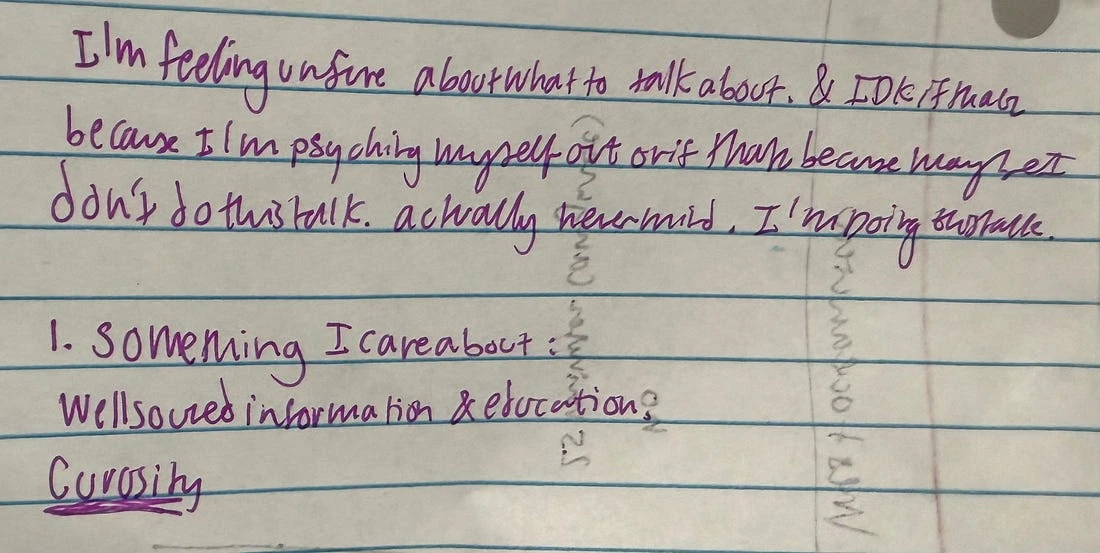
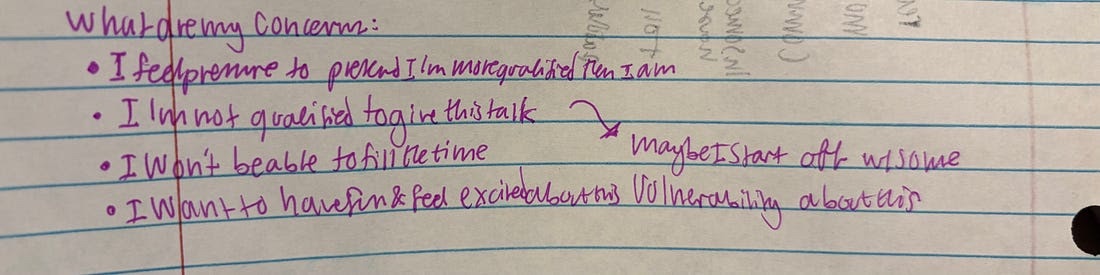
<p>So after doing all of my favorite “productive” procrastination tasks, I had only about an hour to finish prepping. So I started by writing down why I felt so blocked and stuck. Just the act of writing this down helped immensely.</p>

<p><img src="/assets/img/post-resources/staying-current/notes-unsure.webp" alt="Handwritten note in purple ink about feeling unsure what to talk about, followed by &quot;Something I care about: well sourced information and education? Curiosity&quot;" />
<em>I’m feeling unsure about what to talk about, &amp; IDK if that’s because I’m psyching myself out or if that’s because maybe I don’t do this talk. Actually, never mind. I’m doing this talk.</em></p>

<p><img src="/assets/img/post-resources/staying-current/notes-concerns.jpg" alt="Handwritten list of concerns in purple ink" />
<em>What are my concerns? I feel pressure to pretend I’m more qualified than I am. I’m not qualified to give this talk (maybe start off w/ some vulnerability about this). I won’t be able to fill the time. I want to have fun &amp; feel excited about this.</em></p>

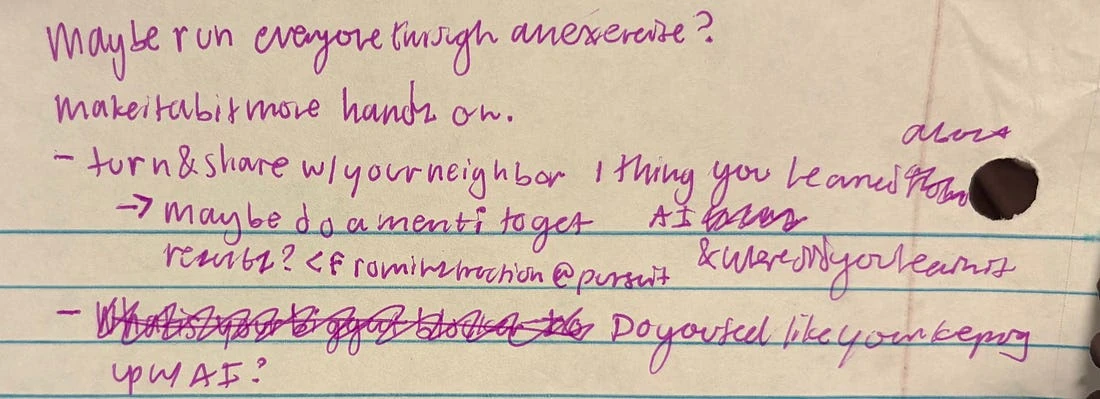
<p><img src="/assets/img/post-resources/staying-current/notes-exercise.webp" alt="Handwritten note in purple ink about running a hands-on exercise" />
<em>Maybe run everyone through an exercise? Make it a bit more hands-on. Turn &amp; share with your neighbor 1 thing you learned about AI &amp; where you learned it. Maybe do a Menti to get results?</em></p>

<p>The ideas that flowed after writing down all of my concerns felt like inspiration from God. I could feel His interest in what I was doing and particularly His love for the people I’d be talking to. This felt comforting and confidence-building.</p>

<p>I didn’t need to talk for 30 minutes; I could make this interactive! I could ask lots of questions and get people involved and engaged with thinking about their AI news feed. Using <a href="https://www.mentimeter.com/">Menti</a> felt like a great fit. This felt like the right direction, and the ideas I had before meshed nicely with my now unblocked ideas.</p>

<p>I reminded myself I chose to do this and I could make it fun! No one was forcing me. I had total control and flexibility over what I’d talk about and could even do a different topic if I wanted.</p>

<p>I was also reminded of other times I’d talked for extended periods about a topic I did not feel any expertise in: Sunday School! In that classroom environment, I try my best to make it interactive, engaging, and fun. I talk about my experience and invite people to share theirs. I also involve God in the process. I realized there was no reason why this presentation opportunity should be any different.</p>

<p>Some things I knew:</p>

<ul>
  <li>
    <p>The actual mechanics of my “AI news feed” are nothing special. It’s not anything to write home about.</p>
  </li>
  <li>
    <p>I am not “trying” to keep up. My purpose is to learn &amp; stay educated. I chose to dig into a couple of topics and not everything, intentionally. As such, I wanted everyone to learn and re-engage with their “purpose” for keeping up with AI.</p>
  </li>
  <li>
    <p>My AI news feed is not static, but evolving. It’s changed a lot, even within the last year.</p>
  </li>
  <li>
    <p>Curiosity is really important. I wanted to encourage curiosity and discourage feeling overwhelmed. I wanted to make things actionable and encourage setting goals.</p>
  </li>
  <li>
    <p>I wanted to have fun.</p>
  </li>
</ul>

<h2 id="post-presentation">Post-presentation</h2>

<p>The audience was different from the first time I talked in front of a cohort at Pursuit. Maybe because of the physical format of the room, people seemed easily disengaged and more interested in their laptops. This cohort was also a level before the one I talked with previously, and I did observe a difference in their skill set and understanding.</p>

<p>People really enjoyed the Menti and engaged with it, but there were probably a few too many questions at the beginning. I think they also liked the ability to follow along with the slides and click on sources, etc.</p>

<p>I got quite a few questions afterwards as well, which was fun. They covered a variety of topics: AI psychosis, getting Chat to speak in hood speak, whether to use Obsidian or Notion, etc.</p>

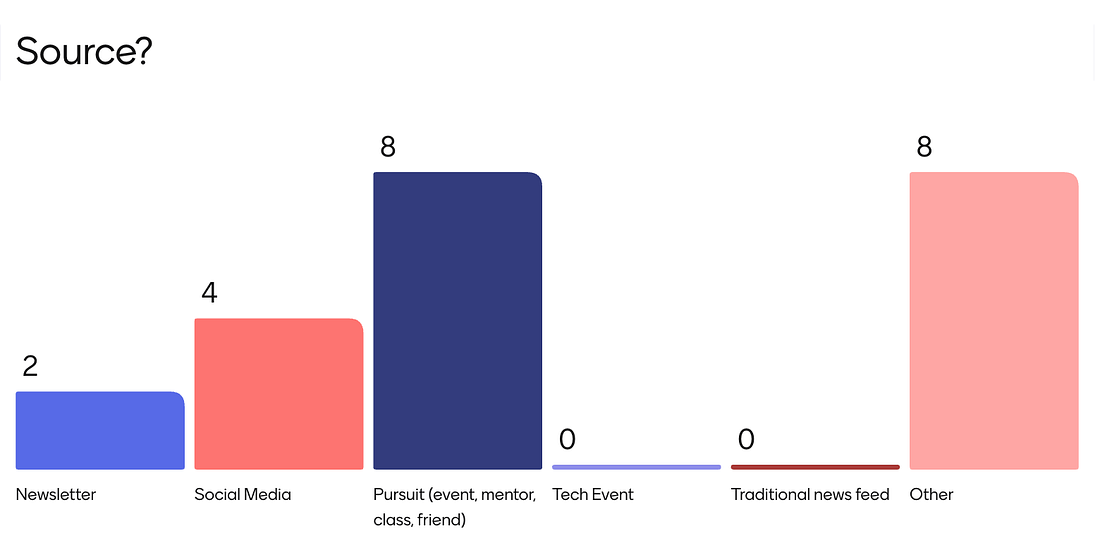
<p>I was surprised by the responses to “What have you learned about AI this week?” I expected the sources to fall under the buckets below. But the “other” bucket ended up being mostly entries from people who learned about AI from talking with AI.</p>

<p><img src="/assets/img/post-resources/staying-current/sources-chart.png" alt="Bar chart titled &quot;Source?&quot;: Newsletter 2, Social Media 4, Pursuit (event, mentor, class, friend) 8, Tech Event 0, Traditional news feed 0, Other 8" /></p>

<p>I really enjoyed the process of teaching and presenting to a group. I found it fun! It felt similar to when I teach Sunday School at church. I also appreciated the accountability and purpose this task gave me. I had a deadline that was self-imposed but not self-enforced, and I would be held accountable.</p>

<p>So, in conclusion, I’m doing another presentation at Pursuit in October on understanding agent harnesses, hehe.</p>]]></content><author><name>Abigail Spigarelli</name></author><summary type="html"><![CDATA[(This was originally presented at Pursuit on June 30th, 2026. Slide deck here. Skip to the end if you want the narrative. Also, it’s not in a “perfect” state, and I need to be fine with that and just publish it. BTW claude only helped clean up the spelling &amp; grammar mistakes.)]]></summary></entry><entry><title type="html">2025 Brag Document</title><link href="https://ajspig.github.io/posts/2026-Brag-Doc/" rel="alternate" type="text/html" title="2025 Brag Document" /><published>2025-12-27T12:18:22+00:00</published><updated>2025-12-27T12:18:22+00:00</updated><id>https://ajspig.github.io/posts/2026-Brag-Doc</id><content type="html" xml:base="https://ajspig.github.io/posts/2026-Brag-Doc/"><![CDATA[<p>TL;DR<br />
Another big year of change and contrast. Worked three separate jobs. Used Teams, Slack, and Discord. Spent 8 months working remotely &amp; 4 in person. Developed with autonomous naval software. Built AI focused developer tooling. And now I’m deep in AI memory infrastructure. First official calendar year as a working woman!<br />
Oh also, I moved to NYC.</p>

<h2 id="goals-for-2025">Goals for 2025</h2>

<p>Get a new job!<br />
Work closer with AI<br />
Leave defense contracting<br />
Move to NYC</p>

<h2 id="goals-for-2026">Goals for 2026</h2>

<p>Work hard and keep shipping things I’m proud of<br />
Pick up consulting or freelance work on the side (Make steps toward more flexibility and independence)<br />
Maintain work boundaries <br />
Learn Spanish<br />
Publish more articles on blog</p>

<h2 id="projects">Projects</h2>

<h3 id="leidos---maritime-jan">Leidos - Maritime (Jan)</h3>

<p><em>Final month on the team before transitioning</em></p>

<ul>
  <li>Planned work roadmap for the new year</li>
  <li>Package management preparations (rpm)</li>
  <li>Owned development of a maneuver in the autonomous software and the Human Machine Interface (HMI)</li>
  <li>Attended an NVIDIA conference on developing with their AI workflows</li>
</ul>

<h3 id="leidos---software-accelerator-feb---oct">Leidos - Software Accelerator (Feb - Oct)</h3>

<p><em>An internal transfer, but drastically different work from my previous role, so  it felt like starting a new job.</em></p>

<ul>
  <li>Evaluated A2A, CrewAI, LangGraph, and other AI frameworks and libraries</li>
  <li>Built a frameworkless agent after internalizing the “agent is just a while loop” insight (ran at half the time and used 1/5th the tokens compared to the framework-dependent approaches)</li>
  <li>Built several agents for simple workflows: Jira automation, automatic data schema, research assistant etc.</li>
  <li>Delivered code to UK and Australia counterparts</li>
  <li>Assisted with packaged service development: Helm charts, Harbor container registry, Kubernetes deployment patterns</li>
  <li>Architected core structure for the legacy VISTA API</li>
  <li>Built a full-stack maritime data visualization system for a prototyped command and control (C2) platform. Backend: FastAPI + PostgreSQL/PostGIS with WebSocket architecture for real-time AIS data streaming.</li>
  <li>Data pipelines: Implemented ingestion for AIS, weather, and mock cargo manifest data</li>
  <li>User research: Planned, organized, and conducted multiple user interviews with warfighters. I gathered feedback and incorporated it into the product roadmap.</li>
</ul>

<p><em>Developer Tooling</em></p>

<ul>
  <li>PR review summarizer script: extracted comments and used an LLM to summarize and sort by priority.</li>
  <li>Claude Code CI/CD integration: took significant initiative to champion this internally and get it integrated into our pipeline.</li>
</ul>

<p><em>Collaboration &amp; Mentorship</em></p>

<ul>
  <li>Mentored team intern Mike.  Introduced him to the team and our codebase. Consistently pair-programmed and helped with his debugging. Provided a touch point for all things Leidos. Sprinkled in some career advice and book recs :)</li>
  <li>Led regular pair programming sessions with coworkers</li>
  <li>Consistently chose to work in-office specifically to collaborate with local teammates</li>
</ul>

<h3 id="plastic-labs-nov-dec">Plastic Labs (Nov-Dec)</h3>

<p><em>Working for a small AI research lab doing developer relations for Honcho, an AI-native memory and personalization platform.</em></p>

<ul>
  <li>Met with builders using the product to understand pain points and gather feedback</li>
  <li>Published integration guides and cookbooks for developers.</li>
  <li>Built a browser extension for granular user activity tracking and assessing the impact of this data in the memory product.</li>
  <li>Dove into memory benchmarks (LoCoMo, LongMemEval, BEAM) and the competitive landscape.</li>
  <li>Daily Twitter publishing. Building a voice for the product and engaging with the AI dev community.</li>
</ul>

<h2 id="what-i-learned">What I learned</h2>

<ul>
  <li>How much I enjoy collaboration. Choosing to work in-office, pair programming, running user interviews. I do better work when I’m not isolated.</li>
  <li>I understand and grow the most when I get my hands dirty.</li>
  <li>What building agents really looks like.</li>
  <li>The complexity and nuance of data pipelines for C2 systems.</li>
  <li>A lot more about twitter and the importance of marketing products well.</li>
</ul>]]></content><author><name>Abigail Spigarelli</name></author><category term="Career" /><category term="brag-document" /><category term="year-in-review" /><category term="software-engineering" /><category term="defense-contracting" /><category term="debugging" /><category term="mentorship" /><summary type="html"><![CDATA[TL;DR Another big year of change and contrast. Worked three separate jobs. Used Teams, Slack, and Discord. Spent 8 months working remotely &amp; 4 in person. Developed with autonomous naval software. Built AI focused developer tooling. And now I’m deep in AI memory infrastructure. First official calendar year as a working woman! Oh also, I moved to NYC.]]></summary></entry><entry><title type="html">A Week Of Claude Code</title><link href="https://ajspig.github.io/posts/A-Week-Of-Claude-Code/" rel="alternate" type="text/html" title="A Week Of Claude Code" /><published>2025-08-09T12:18:22+00:00</published><updated>2025-08-09T21:00:46+00:00</updated><id>https://ajspig.github.io/posts/A-Week-Of-Claude-Code</id><content type="html" xml:base="https://ajspig.github.io/posts/A-Week-Of-Claude-Code/"><![CDATA[<p>This week at work I had the chance to spend some time working with Claude Code and I loved it!</p>

<p>I’ve already processed a lot of information about Claude Code, so I started off feeling pretty comfortable with using it.  I am so aware there is a lot about Claude Code out there, so my remarks will really only focus on my experience. Additionally, if there is one thing that is true, its that the AI industry moves fast. Who knows… will this article be completely irrelevant in 1 month or in 1 year? So I’ll try and balance the constant and the trendy.</p>

<p>Context: I’ve used Claude code for a variety of different tasks, but I primarily tested it with a brand new project and an existing + extensive + open source project.</p>

<p><img src="/assets/img/post-resources/C.E._Shannon.jpg" alt="Claude Shannon" /></p>

<p><em>Did you know that Claude was possibly named after the Mathematician <a href="https://web.archive.org/web/20230712235416/https://www.nytimes.com/2023/07/11/technology/anthropic-ai-claude-chatbot.html">Claude Shannon</a>?</em></p>

<h2 id="what-did-surprise-me">What did surprise me</h2>

<p>I knew Claude Code was run in the terminal, but I didn’t realize it mattered where it run. I love that approach to <strong>context control.</strong> It felt like a very practical and intuitive design choice.</p>

<p>The Claude.md file was more helpful then I gave it credit for helping Claude process a large codebase. It really simplified the <strong>context</strong> <strong>gathering</strong> later on. It is less helpful for smaller projects you might be starting from scratch.</p>

<p>The initial <strong>tools</strong> were limited. I didn’t realize it wouldn’t have access to the web right off the bat. I didn’t experiment with other tools, preferring to keep it quite bare-bones.</p>

<h2 id="other-notes">Other Notes</h2>

<p>Claude code is so fun to work with. I seriously went so much farther then I would have normally. Getting into a <strong>flow</strong> <strong>state</strong> was significantly easier.</p>

<p><strong>Reading text isn’t fun</strong>. Andrej Karpathy in his talk <a href="https://www.youtube.com/watch?v=LCEmiRjPEtQ">Software Is Changing (Again)</a> emphasizes speeding up the cycle between generation and verification. Like Andrej said “reading text is effortful and not fun.” Reading Claude’s diffs was fun only because I was excited about using Claude.  Sometimes the text was quite extensive as the diffs grew. My normal coding practice involves small incremental diffs, so this could feel quite foreign and frustrating.</p>

<p>I love that it is <strong>platform agnostic</strong>. It makes it so easy to work with it regardless of your IDE. This resolves some serious pain points and makes it a lot easier for teams to incorporate without hiccups.</p>

<p>I loved using with <strong>git</strong>! The amount of times I need to look up basic git commands that I only use semi often is frankly embarrassing, so this felt like a godsend. Using it to synthesize information collected from the gitlog was so easy and so helpful when I worked on the open source project.</p>

<p>I felt most comfortable using claude if I had a good idea of <strong>what I wanted</strong>. Blindly accepting suggestions is just not my m.o. I know it will break eventually and I know the frustration that will ensue  <em>if</em> i know what is going on, let alone if I have no idea. I am not a masochist.</p>]]></content><author><name>Abigail Spigarelli</name></author><category term="Software Development" /><category term="AI Tools" /><category term="Developer Experience" /><category term="Developer Tools" /><category term="Software Engineering" /><category term="Technical Opinion" /><category term="AI Tools" /><category term="Claude Code" /><summary type="html"><![CDATA[This week at work I had the chance to spend some time working with Claude Code and I loved it!]]></summary></entry><entry><title type="html">SCons</title><link href="https://ajspig.github.io/posts/Scons/" rel="alternate" type="text/html" title="SCons" /><published>2025-05-31T12:18:22+00:00</published><updated>2025-06-02T00:05:36+00:00</updated><id>https://ajspig.github.io/posts/Scons</id><content type="html" xml:base="https://ajspig.github.io/posts/Scons/"><![CDATA[<p>Some thoughts from the backlog about SCons, a python scripting tool I had the pleasure of using.</p>

<p><strong>TLDR; don’t use it. Just stick with CMake or any other build tool. And if you only read one thing: <a href="#some-lessons-learned">Some Lessons Learned</a>.</strong></p>

<p><img src="/assets/img/post-resources/SCons/Buttermilk-Scones-batch.jpg" alt="Scones" /></p>

<p><em>As wiki explains: don’t confuse it with “scones” <a href="https://en.wikipedia.org/wiki/SCons">Source</a></em></p>

<h2 id="but-if-not-a-scone-what-is-scons">But if not a Scone, what is SCons?</h2>
<p>A python build tool that famously ignores environment variables (think CFLAGS) and is comparable to CMake.</p>

<p>Pros</p>

<ul>
  <li>Python</li>
  <li>Reliable dependency analysis (supposedly)</li>
</ul>

<p>Cons</p>

<ul>
  <li>Support for library versioning is absent</li>
  <li>Ignores environment variables and path variables (unusual behavior)</li>
  <li>There are very limited resources, examples, and documentation</li>
  <li>No Automation possible (worst feature)
    <ul>
      <li>Because every SCons script is unique, and commonality is not enforced and making automation effectively unattainable</li>
    </ul>
  </li>
</ul>

<h2 id="what-others-think">What Others Think</h2>

<p>As I was compiling some of my thoughts about SCons I did some research… and I felt so validated.</p>

<blockquote>
  <p>“Please don’t use SCons. It is hard to use it correctly. For instance SCons is designed to ignore environment variables such as CFLAGS (unless your add code for this). It also does not support DESTDIR out of the box. As an upstream you have to explicitly add code for that (or Debian has to patch). Support for SONAMEs (library versioning) is also absent. The general observation is that many projects, that use SCons, do not have a working install target. Since projects work around these limitations individually there is no way to just use a SCons project in Debian, but more work is required to invoke it correctly.” <a href="https://wiki.debian.org/UpstreamGuide#SCons:~:text=can%20override%20them.-,SCons,-Please%20don%27t%20use">Source</a></p>
</blockquote>

<blockquote>
  <p>“SCons lacks many basic features required from a complete build system and thus it is mostly about reimplementing the wheel a dozen times. And doing that means a lot of pain to users and developers which have to adjust to custom solutions and be hit by repeating bugs in custom implementations.” <a href="https://wiki.gentoo.org/wiki/SCons#Arguments_against_using_SCons_for_a_project">Source</a>
 (this site also includes a more detailed list of cons)</p>
</blockquote>

<h2 id="my-experience-and-opinion">My experience and opinion</h2>

<p>I wasn’t exposed to SCons until working in the industry. My prior experience with build tools was with CMake. I found my dislike for SCons grew the more I used it. My opinion is not divorced from other factors related to my work with SCons, but regardless I have found it an inconvenient and challenging build tool.</p>

<p>Our project was way too complex for SCons. Our SCon scripts were ridiculously long and exceptionally complex. I never truly understood what was really in these SCon scripts, and if I needed a new one, I’d just copy an old one. And I wasn’t alone. I didn’t know anyone on our team who actually wrote a SCons script. Imagine this happening for decades and you are looking at some very bloated and uncomfortably long scripts each slightly different from their predecessor.</p>

<p>Ideally I will never use SCons again. From my research I found it is not a popular build tool (I wonder why?) and I doubt many people will ever even hear the word SCons. So why is this experience at all relevant?</p>

<h2 id="some-lessons-learned">Some Lessons Learned</h2>

<ul>
  <li>How did this happen? How did the build system never get upgraded as the software grew in complexity?
    <ul>
      <li>What is easy: “It works, don’t touch it.” What is hard: Looking at the big picture and updating and readdressing pain points as things grow. One mentality leads to growth, the other to stagnation.</li>
    </ul>
  </li>
  <li>How could this be improved?
    <ul>
      <li>Update the build system.</li>
      <li>For my team there was no hope. The inconvenience of using SCons was actually a very minor problem that will likely never be addressed. But given the right people and emergency scenario it could happen!</li>
      <li>Everyone will struggle with introducing change whether that be new processes, protocols, software or whatever. They are hard to adopt and they are hard to change. This reminded me of the following heuristic: <em>how</em> you introduce technological and social change is often more important than <em>what</em> you do.</li>
    </ul>
  </li>
  <li>What to consider before using unfamiliar software:
    <ul>
      <li>Community Support —&gt; doesn’t feel important until you run into an issue</li>
      <li>Toolchain —&gt; Ensure the build system you choose integrates well with your preferred toolchain</li>
      <li>Learning Curve —&gt; It will take time to learn a new build system</li>
    </ul>
  </li>
</ul>

<h2 id="if-scons-is-not-it-what-is-the-solution-a-couple-of-brief-thoughts">If SCons is not it, what is the solution? A couple of brief thoughts</h2>

<p>CMake is the most obvious/best solution.</p>

<p>There are a lot of different things you could look at depending on software size, complexity of tool, speed of build etc. Bazel could be a good pick for large complex projects. Another popular tool is Meson. It is newer and open source. It also integrates well with Ninja and can be faster and easier to learn than CMake.</p>

<p><img src="/assets/img/post-resources/SCons/sconce.jpg" alt="Sconce" /></p>

<p><em>A Sconce, Also not SCons <a href="https://www.amazon.com/Lightess-Dimmable-Bedroom-Hallway-O1185TP/dp/B08FR8B1M9">Source</a></em></p>

<p><em>Disclaimer:</em> This is a pretty opinionated piece mostly based on personal experience and research. Please reach out if you’ve had a positive experience with SCons. I would love to hear about what worked well for you!</p>]]></content><author><name>Abigail Spigarelli</name></author><category term="Software Development" /><category term="Build Tools" /><category term="SCons" /><category term="CMake" /><category term="Build Systems" /><category term="Python" /><category term="Software Engineering" /><category term="Developer Tools" /><category term="Bazel" /><category term="Meson" /><category term="Technical Opinion" /><summary type="html"><![CDATA[Some thoughts from the backlog about SCons, a python scripting tool I had the pleasure of using.]]></summary></entry><entry><title type="html">Visiting Machu Picchu</title><link href="https://ajspig.github.io/posts/Visiting-Machu-Picchu/" rel="alternate" type="text/html" title="Visiting Machu Picchu" /><published>2025-04-06T12:18:22+00:00</published><updated>2025-04-24T01:00:01+00:00</updated><id>https://ajspig.github.io/posts/Visiting-Machu-Picchu</id><content type="html" xml:base="https://ajspig.github.io/posts/Visiting-Machu-Picchu/"><![CDATA[<h2 id="what-it-costs-to-visit-machu-picchu-in-spring-of-2025">What it Costs to Visit Machu Picchu in Spring of 2025</h2>

<p><img src="/assets/img/post-resources/AR509615_Original.jpeg" alt="Machu Picchu" />
<em>Photo Credit: <a href="https://michaelparkphotos.mypixieset.com/">Michael Park</a></em></p>

<h2 id="introduction">Introduction</h2>

<p>Machu Picchu – one of the most iconic travel destinations in the world. You’ve probably heard about it your whole life, but does it live up to the hype? And what is the true cost of experiencing one of the Seven Wonders of the World?</p>

<p><strong>TLDR:</strong> There are other wonderful ruins besides Machu Picchu. Get out there and explore!</p>

<p>In this blog post, I will try to answer these questions by detailing the expenses (on a budget!) and experience of visiting Machu Picchu and other comparable ruins in March 2025.</p>

<hr />

<h3 id="timing">Timing</h3>

<p>When should you go? Machu Picchu receives 1.6 million visitors per year. According to the official Machu Picchu Tickets Site, they increase the number of tickets available during busier months. Since 2024, Machu Picchu authorities have authorized dynamic capacity based on high and low seasons.</p>

<ul>
  <li><strong>High Season:</strong> June 1 to October 15 (and holidays like Christmas, New Year’s Day, and Independence Day - July 28) — up to <strong>5,600 visitors per day</strong>.</li>
  <li><strong>Low Season:</strong> October 16 to May 31 — up to <strong>4,500 visitors per day</strong>.</li>
</ul>

<p>The least busy months are <strong>January, February, and March</strong>, but the <strong>rainy season (December through March)</strong> can impact travel. This affected my trip — a mudslide canceled my Huayna Picchu hike.</p>

<p>Expect to need <strong>at least 3 days</strong> to see Machu Picchu. I spent two weeks in Peru, but the following expenses are for a <strong>three-day</strong> trip (prices in USD):</p>

<hr />

<h3 id="transportation">Transportation</h3>

<p>Getting to Machu Picchu is the hardest part.</p>

<p>I flew from D.C. to Lima (round trip), then Lima to Cusco. From Cusco to Aguas Calientes, you can either hike the Inca Trail (multi-day trek) or take a train. Once in Aguas Calientes, you either buy a bus ticket or hike 2 hours to the ruins (mostly along a narrow winding road).</p>

<blockquote>
  <p><strong>Note:</strong> Flights only included a personal item. Expect to pay $30–$70 more per flight for additional luggage.</p>
</blockquote>

<table>
  <thead>
    <tr>
      <th>Expense</th>
      <th>Cost (USD)</th>
    </tr>
  </thead>
  <tbody>
    <tr>
      <td>Flight from D.C. to Lima (round trip)</td>
      <td>382.87</td>
    </tr>
    <tr>
      <td>Flight from Lima to Cusco (round trip)</td>
      <td>69.66</td>
    </tr>
    <tr>
      <td>Train from Cusco to Aguas Calientes (round trip)</td>
      <td>136.80</td>
    </tr>
    <tr>
      <td>Bus from Aguas Calientes to Machu Picchu (round trip)</td>
      <td>24</td>
    </tr>
    <tr>
      <td>Uber/taxi/bus to/from airports in Lima and Cusco</td>
      <td>16</td>
    </tr>
    <tr>
      <td><strong>Total</strong></td>
      <td><strong>629.33</strong></td>
    </tr>
  </tbody>
</table>

<hr />

<h3 id="accommodations">Accommodations</h3>

<p>I stayed in Lima and Cusco before reaching Aguas Calientes. Aguas Calientes, being tourist-heavy, had the most expensive and lowest-quality stay (right next to the train station — not ideal).</p>

<table>
  <thead>
    <tr>
      <th>Location</th>
      <th>Cost (USD)</th>
    </tr>
  </thead>
  <tbody>
    <tr>
      <td>Lima Airbnb</td>
      <td>11.40</td>
    </tr>
    <tr>
      <td>Cusco Hostel</td>
      <td>9.38</td>
    </tr>
    <tr>
      <td>Aguas Calientes Hostel</td>
      <td>12.00</td>
    </tr>
    <tr>
      <td><strong>Total</strong></td>
      <td><strong>32.78</strong></td>
    </tr>
  </tbody>
</table>

<hr />

<h3 id="food">Food</h3>

<p>Peruvian food is incredible! I didn’t eat in Cusco due to timing, but meals in Aguas Calientes were comparable in price to Lima, though lower in quality.</p>

<table>
  <thead>
    <tr>
      <th>Meal</th>
      <th>Cost (USD)</th>
    </tr>
  </thead>
  <tbody>
    <tr>
      <td>Lima Dinner</td>
      <td>12.01</td>
    </tr>
    <tr>
      <td>Lima Breakfast</td>
      <td>6.00</td>
    </tr>
    <tr>
      <td>Lima Lunch</td>
      <td>13.10</td>
    </tr>
    <tr>
      <td>Aguas Calientes Lunch</td>
      <td>10.86</td>
    </tr>
    <tr>
      <td>Aguas Calientes Dinner</td>
      <td>1.70</td>
    </tr>
    <tr>
      <td>Aguas Calientes Snacks/Water</td>
      <td>10.00</td>
    </tr>
    <tr>
      <td>Aguas Calientes “Linner” (Post-Machu Picchu)</td>
      <td>5.63</td>
    </tr>
    <tr>
      <td><strong>Total</strong></td>
      <td><strong>59.30</strong></td>
    </tr>
  </tbody>
</table>

<hr />

<h3 id="machu-picchu">Machu Picchu</h3>

<p>I bought tickets weeks in advance. Originally purchased Route 1 and Route 3 (Huayna Picchu hike), but Route 3 was closed due to a mudslide. I joined a group of tourists to split the cost of a guide.</p>

<blockquote>
  <p><strong>Note:</strong> Expect to pay for bathrooms!</p>
</blockquote>

<table>
  <thead>
    <tr>
      <th>Expense</th>
      <th>Cost (USD)</th>
    </tr>
  </thead>
  <tbody>
    <tr>
      <td>Two-Time Entry Tickets</td>
      <td>97.76</td>
    </tr>
    <tr>
      <td>Tour Guide (with tip)</td>
      <td>21.88</td>
    </tr>
    <tr>
      <td>Bathroom Visit</td>
      <td>0.65</td>
    </tr>
    <tr>
      <td><strong>Total</strong></td>
      <td><strong>120.13</strong></td>
    </tr>
  </tbody>
</table>

<hr />

<h3 id="grand-total">Grand Total</h3>

<table>
  <thead>
    <tr>
      <th>Category</th>
      <th>Total (USD)</th>
    </tr>
  </thead>
  <tbody>
    <tr>
      <td>Transportation</td>
      <td>629.33</td>
    </tr>
    <tr>
      <td>Accommodations</td>
      <td>32.78</td>
    </tr>
    <tr>
      <td>Food</td>
      <td>59.30</td>
    </tr>
    <tr>
      <td>Machu Picchu</td>
      <td>120.13</td>
    </tr>
    <tr>
      <td><strong>Total</strong></td>
      <td><strong>841.54</strong></td>
    </tr>
  </tbody>
</table>

<hr />

<h3 id="some-ways-to-make-it-cheaper">Some Ways to Make It Cheaper</h3>

<ul>
  <li>Skip Lima and go directly to Cusco (<strong>~-$20</strong>)</li>
  <li>Only do one Machu Picchu route (<strong>-$42</strong>)</li>
  <li>Visit Machu Picchu without a guide (<strong>-$21.88</strong>)</li>
  <li>Hike instead of using the bus (<strong>-$24</strong>)</li>
  <li>Hike the Inca Trail (<em>Note: not cheaper, but a different experience!</em>)</li>
</ul>

<hr />

<h3 id="what-if-youre-already-in-peru">What if You’re Already in Peru?</h3>

<p>If you’re already planning to visit Lima and Cusco and are considering Machu Picchu, here’s the <strong>additional cost</strong>:</p>

<table>
  <thead>
    <tr>
      <th>Expense</th>
      <th>Cost (USD)</th>
    </tr>
  </thead>
  <tbody>
    <tr>
      <td>Train (Cusco to Aguas Calientes round trip)</td>
      <td>136.80</td>
    </tr>
    <tr>
      <td>Bus (Aguas Calientes to Machu Picchu)</td>
      <td>24</td>
    </tr>
    <tr>
      <td>Two-Time Entry Tickets</td>
      <td>97.76</td>
    </tr>
    <tr>
      <td>Tour Guide</td>
      <td>21.88</td>
    </tr>
    <tr>
      <td>Bathroom Visit</td>
      <td>0.65</td>
    </tr>
    <tr>
      <td>Food in Aguas Calientes (3 meals)</td>
      <td>30</td>
    </tr>
    <tr>
      <td>Accommodations (1 night)</td>
      <td>12</td>
    </tr>
    <tr>
      <td><strong>Total</strong></td>
      <td><strong>323.09</strong></td>
    </tr>
  </tbody>
</table>

<hr />

<h2 id="experience">Experience</h2>

<p><img src="/assets/img/post-resources/MP.jpeg" alt="Rainy and Realistic Machu Picchu" />
<em>Rainy and Realistic Machu Picchu</em></p>

<p>Machu Picchu is breathtaking — even in pouring rain. The terracing is stunning, and slowly sinking under the weight of tourism. The stones are a perfect fit… in some places. It’s a once-in-a-lifetime experience — <strong>emphasis on once</strong>. I don’t plan to return or take my family. There are equally impressive and less-visited ruins around the world. Machu Picchu checked a bucket list box, but one visit is enough for me.</p>

<hr />

<h2 id="other-comparable-ruins">Other Comparable Ruins</h2>
<p><img src="/assets/img/post-resources/cusco.jpeg" alt="Sacsayhuaman in Cusco" />
<em>Sacsayhuaman in Cusco</em></p>

<p>Cusco is surrounded by ruins showcasing beautiful stonework. The <strong>Sacred Valley</strong> to the north offers large, accessible ruins.</p>

<p>I also loved the ruins in <strong>Colca Canyon</strong>. The towns of <strong>Chivay</strong> and <strong>Yanque</strong> nearby feature stunning Incan ruins — about as remote but far less crowded than Machu Picchu.</p>

<hr />

<h2 id="conclusion">Conclusion</h2>
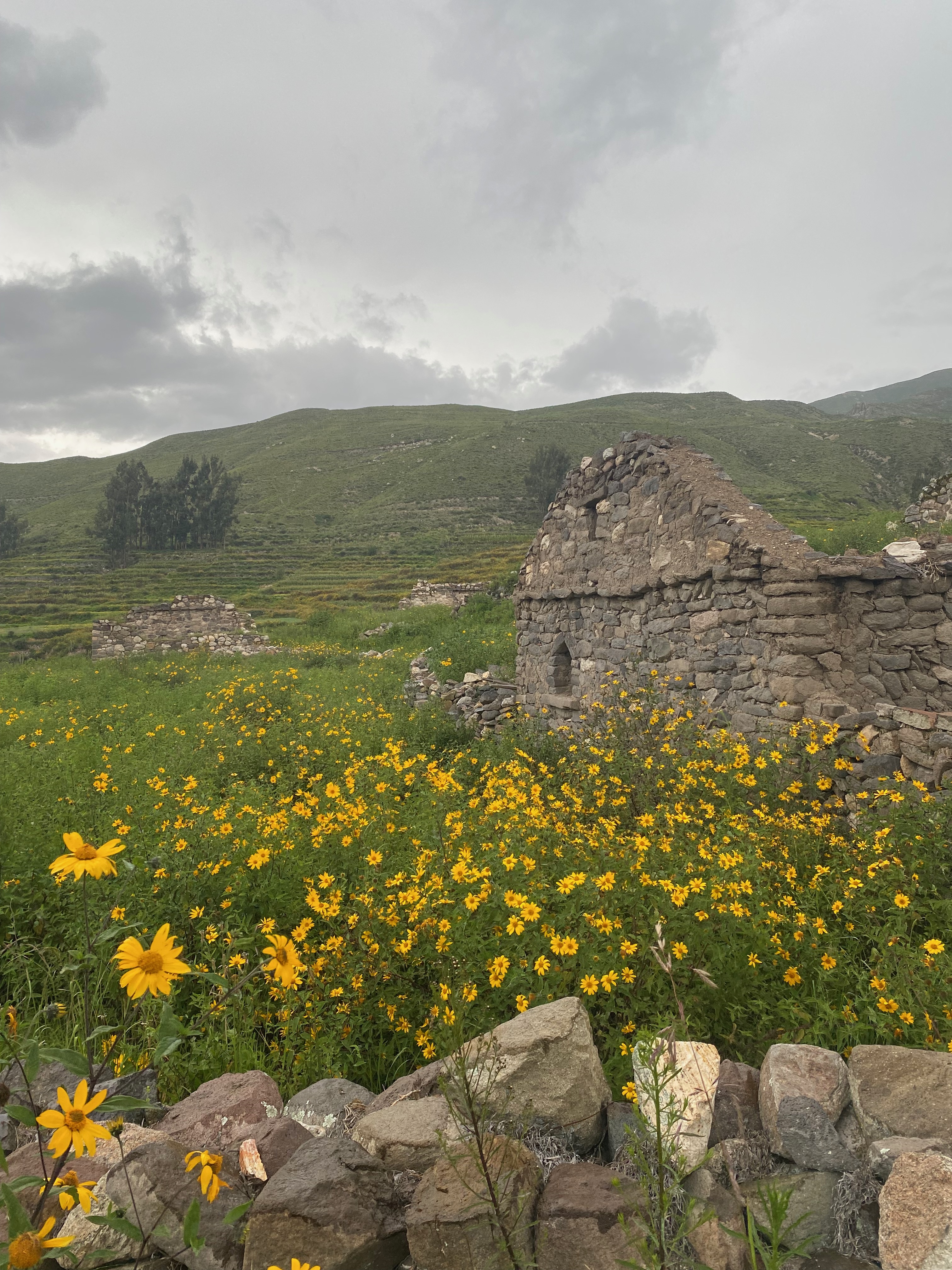
<p><img src="/assets/img/post-resources/uyouyo.jpeg" alt="Conclusion" /> <em>Beautiful Wild Flowers in Uyo Uyo Ruins in Yanque</em></p>

<p>Machu Picchu was closed for two years during COVID and for preservation. There are rumors of future closures, so if it’s on your bucket list — go soon.</p>

<p>But don’t overlook the other incredible ruins in Peru!</p>]]></content><author><name>Abigail Spigarelli</name></author><category term="Travel" /><category term="Finances" /><category term="Peru" /><summary type="html"><![CDATA[What it Costs to Visit Machu Picchu in Spring of 2025]]></summary></entry><entry><title type="html">2024 Brag Document</title><link href="https://ajspig.github.io/posts/2024-Brag-Doc/" rel="alternate" type="text/html" title="2024 Brag Document" /><published>2024-12-26T12:18:22+00:00</published><updated>2026-11-26T04:26:26+00:00</updated><id>https://ajspig.github.io/posts/2024-Brag-Doc</id><content type="html" xml:base="https://ajspig.github.io/posts/2024-Brag-Doc/"><![CDATA[<p>TLDR; Moved from Utah to VA. Started my first full time job and quickly went from onboarding to becoming the person who onboards others. Solved ambiguous bugs, supported critical test events, and assisted an internal research project.</p>

<h2 id="goals-for-2024">Goals for 2024</h2>

<p>Get my first post-grad job!<br />
Move out of Utah.</p>

<h2 id="goals-for-2025">Goals for 2025</h2>

<p>Get a new job!<br />
Work closer with AI<br />
Leave defense contracting<br />
Move to NYC</p>

<h2 id="projects">Projects</h2>

<h3 id="byu-january---april">BYU (January - April)</h3>

<p><em>Last Semester of Bachelors Degree in Computer Science</em></p>

<ul>
  <li>Took a full course load of both fun (gymnastics!) and career oriented classes (databases!)</li>
  <li>Attended networking events both on and off campus.</li>
  <li>Extensive preparation for interviews.</li>
</ul>

<h3 id="leidos---maritime-may--december">Leidos - Maritime (May- December)</h3>

<ul>
  <li><strong>Process Optimization</strong>: Consistently looked for small adjustments that made large course corrections. Updated Bitbucket default settings to reduce dead code and repo clutter. Pushed for and created a delivery script that improved software delivery efficiency to customers by over 10x (required substantial problem-solving as it coincided with our migration from RHEL 7 to RHEL 8).</li>
  <li><strong>Bug Resolution</strong>: Resolved an ambiguous bug in a remote control platform. Required extensive collaboration and digging through systemd journals, kernel dumps, and various logs. The software was delivered back to the customer in an improved state because of other improvements made during the investigation.</li>
  <li><strong>Test Event Support</strong>: Supported an on-water test event for new software releases. Required extensive troubleshooting and extending the trip through the weekend. After literally checking from the mast to the engine room, we finally fixed the issue. Upon returning, I pushed for pre-trip and post-trip briefings, requested sitreps to increase project visibility, and advocated for a retro meeting. This has since been applied to future trips.</li>
  <li><strong>Internal Research Project</strong>: Advocated for leveraging third-party libraries (navigating the legal complexities) and saved the team weeks of development effort. Also supported the data capture event, which included significant troubleshooting to set up the testing environment.</li>
  <li><strong>Collaboration and Mentorship:</strong> After only three months, I was trusted to assist with onboarding, standing out as the only one from my cohort to do so. Well on the team I would onboarded 10+ new team members. Additionally, I led approximately 40 pair programming sessions throughout the year and consistently sought opportunities to build my network at Leidos (including attending employee events in person, working from the Reston HQ etc.)</li>
</ul>

<h2 id="what-i-learned">What I learned</h2>

<ul>
  <li>Working closely with the rawness of hardware is awesome. I love the tactical nature of literally building, but it also has its own frustrations</li>
  <li>I love making things more efficient</li>
  <li>I enjoy working in person</li>
  <li>Loved the east coast!</li>
</ul>]]></content><author><name>Abigail Spigarelli</name></author><category term="Career" /><category term="brag-document" /><category term="year-in-review" /><category term="software-engineering" /><category term="defense-contracting" /><category term="debugging" /><category term="mentorship" /><summary type="html"><![CDATA[TLDR; Moved from Utah to VA. Started my first full time job and quickly went from onboarding to becoming the person who onboards others. Solved ambiguous bugs, supported critical test events, and assisted an internal research project.]]></summary></entry><entry><title type="html">Notes From Launching</title><link href="https://ajspig.github.io/posts/Notes-From-Launching/" rel="alternate" type="text/html" title="Notes From Launching" /><published>2024-11-29T12:18:22+00:00</published><updated>2024-12-03T03:12:24+00:00</updated><id>https://ajspig.github.io/posts/Notes-From-Launching</id><content type="html" xml:base="https://ajspig.github.io/posts/Notes-From-Launching/"><![CDATA[<h2 id="launching-my-personal-website-a-journey">Launching My Personal Website: A Journey</h2>

<p>I’m excited to share my new personal website! My first personal website was created in a web programming class. However, after shutting down everything hosted on AWS, it no longer exists. It also had a “clever” name that proved confusing. Was it “abby spig”? Or was it “abby’s pig”? Clearly, it was time for a new and improved personal site.</p>

<p><img src="/assets/img/post-resources/abby-spig-click.png" alt="Screenshot of my old website" /></p>

<p>Here’s a quick rundown of why I built the site, the challenges I faced, and what I’d do differently next time.</p>

<hr />

<h2 id="why-build-a-personal-website">Why Build a Personal Website?</h2>

<p>I wanted a space to capture and share my thoughts and experiences. A personal website offers the freedom to blog and practice my development skills without relying on social media platforms. I also find it helpful to record my thoughts and ideas so this is simply a natural extension of work I already do.</p>

<hr />

<h2 id="choosing-the-right-tools">Choosing the Right Tools</h2>

<p>I considered several options before settling on <strong>Jekyll with GitHub Pages</strong>. Here’s why:</p>

<ul>
  <li><strong>Free Hosting</strong>: I needed something budget-friendly with room to scale later.</li>
  <li><strong>Simplicity &amp; Flexibility</strong>: I wanted a simple solution that could grow over time.</li>
</ul>

<p>After exploring options like plain HTML/CSS, Gatsby, and React, I chose Jekyll because of its ease of use and strong community support.</p>

<hr />

<h2 id="what-went-well">What Went Well</h2>

<ul>
  <li><strong>Theme Choice</strong>: <a href="https://chirpy.cotes.page/posts/getting-started/">Chirpy theme</a>; Its clean layout and sidebar are perfect for blogging.</li>
  <li><strong>Local Development Setup</strong>: Running Jekyll locally made testing changes quick and efficient.</li>
  <li><strong>GitHub Pages Hosting</strong>: Free, reliable, and easy to set up—perfect for a starting point.</li>
</ul>

<hr />

<h2 id="challenges--mistakes">Challenges &amp; Mistakes</h2>

<p>While following GitHub’s <a href="https://docs.github.com/en/pages/setting-up-a-github-pages-site-with-jekyll/about-github-pages-and-jekyll">tutorial</a>, I encountered a few hiccups:</p>

<ol>
  <li><strong>Wrong Starting Point</strong>: I initially followed the github tutorial, but it would have been more straightforward to pick the theme first and start with the theme’s specific guide (I used <a href="https://chirpy.cotes.page/posts/getting-started/">Chirpy</a>.)</li>
  <li><strong>Favicon and Avatar Issues</strong>: I struggled with customizing the favicon and avatar. Ultimately, these challenges taught me a lot about the build process. Lesson learned: Read instructions carefully!</li>
  <li><strong>Post File Naming</strong>: I misunderstood how to name posts. Files should follow the format <code class="language-plaintext highlighter-rouge">YYYY-MM-DD-TITLE.extension</code>, but I initially skipped the title part. Lesson learned: Once again read the instructions!</li>
</ol>

<hr />

<h2 id="next-steps">Next Steps</h2>

<ul>
  <li><strong>Post More Frequently</strong>: Aim for weekly posts summarizing ideas and projects.</li>
  <li><strong>Update the URL</strong>: Transition to a custom domain like <code class="language-plaintext highlighter-rouge">abigailspigarelli.net</code>.</li>
  <li><strong>Add Commenting Abilities</strong>: Encourage reader interaction.</li>
  <li><strong>Integrate Analytics</strong>: Track site performance and visitor engagement.</li>
  <li><strong>Refine the Design</strong>: Continue tweaking the layout and visual elements.</li>
  <li><strong>Explore Backend Components</strong>: Experiment with backend work to enhance the site’s functionality.</li>
</ul>

<hr />

<h2 id="final-thoughts">Final Thoughts</h2>

<p>Building this site was a great learning experience, and I’m happy with the results. I look forward to iterating on it :)</p>

<p>Thanks for reading! Stay tuned for more updates.</p>

<hr />]]></content><author><name>Abigail Spigarelli</name></author><category term="Personal Projects" /><category term="Web Development" /><category term="jekyll" /><category term="chirpy" /><category term="web development" /><category term="personal website" /><category term="blogging" /><category term="github pages" /><summary type="html"><![CDATA[Launching My Personal Website: A Journey]]></summary></entry></feed>